SEED GRANT
TITLE: Objective Continuous Assessment of Nurses’ Trust in Artificial Intelligence Healthcare Technologies
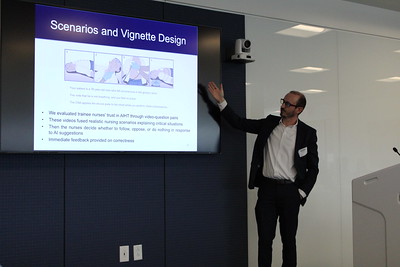
Dr. Hugo F. Posada-Quintero presenting at the 2025 Nursing and Engineering Innovation Forum
MEMBERS: Hugo F. Posada-Quintero , PhD, Valorie MacKenna , PhD, RN, CNE, CHSE, Wendy A. Henderson, PhD, MSN, CRNP, FAAN
DESCRIPTION: This project aims to develop a noninvasive, continuous way to measure nurses’ trust in AI healthcare tools using electrodermal activity (EDA) and machine learning. This would replace current surveys and help improve safety, performance, and collaboration between nurses and AI.
IMPACT: In a collaboration between nursing and engineering, our team set out to answer one of the most pressing questions in modern healthcare. Can we truly understand how much nurses trust the artificial intelligence tools designed to support their clinical decisions? Trust is essential for the safe and effective use of AI in healthcare. Too little trust can lead to the underuse of helpful technologies, while too much trust can result in dangerous overreliance. However, trust is currently measured almost exclusively through occasional questionnaires, which cannot capture how feelings shift moment-to-moment during real clinical decision-making. To address this issue, we developed an innovative simulation platform and experimental framework that combines immersive clinical scenarios, wearable physiological sensors, and advanced machine learning. Our multidisciplinary team of nurses, engineers, psychologists, and designers created a library of realistic, illustrated clinical vignettes, complete with narration and subtle animation, to place participants in lifelike, high-stakes situations where AI provides guidance. As participants make decisions, we collect continuous electrodermal activity (EDA) and performance data and record subjective evaluations of trust. This allows us to see how trust evolves second by second. We are developing the first Objective Biomarker of Trust (OBT) in AI healthcare technologies using these data. The OBT is a non-invasive, continuous measure derived from physiological signals. This tool has the potential to transform how clinicians are trained to work with AI, how AI systems are designed, and how patient safety is monitored in environments where humans and intelligent technologies must collaborate. The project has already accelerated innovation at UConn. It has brought on new collaborators, including a Fulbright Visiting Scholar, and generated additional external funding to expand our work. It has also established a robust, reusable testbed for future human-AI research at the Nursing and Engineering Innovation Center. By combining advanced sensing, thoughtful simulations, and interdisciplinary expertise, we are paving the way for safer and more reliable partnerships between nurses and AI tools that are rapidly becoming part of everyday clinical care. This work establishes UConn as a leader in understanding and shaping the future of trust in healthcare technology.
TITLE: Feasibility of Mapping Changes in Tissue Depth in Adults While Sucking
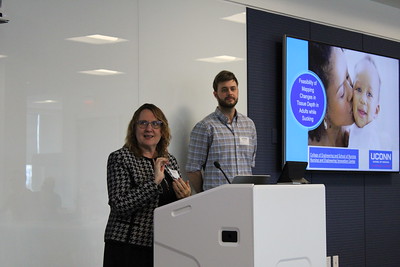 Dr. Ruth Lucas and James F. Stevens presenting at the 2025 Nursing and Engineering Innovation Forum
MEMBERS: Ruth Lucas, PhD, RNC, CLS, FAAN, Dr. Martin Huber, PhD, James F. Stevens, Confidence C. Francis-Edoziuno, Clyde D’Souza
DESCRIPTION: This project tests a simple, noninvasive way to measure mouth pressure and movement, with the goal of safely studying how babies feed without using devices inside their mouths.
SENIOR DESIGN
TITLE: Pulse Oximetry to Account for Variations in the Skin Spectrum

Dr. Ruth Lucas and James F. Stevens presenting at the 2025 Nursing and Engineering Innovation Forum
MEMBERS: Dr. Kazunori Hoshino PhD, Dr. Mallory Perry-Eaddy PhD RN CCRN
DESCRIPTION: Traditional pulse oximeters can be less accurate for patients with darker skin tones, leading to missed or delayed care. Our project aims to fix this by adding a compact spectrometer to measure skin absorption more precisely, creating a more accurate and inclusive tool for detecting low blood oxygen in all patients.